

The one-look test
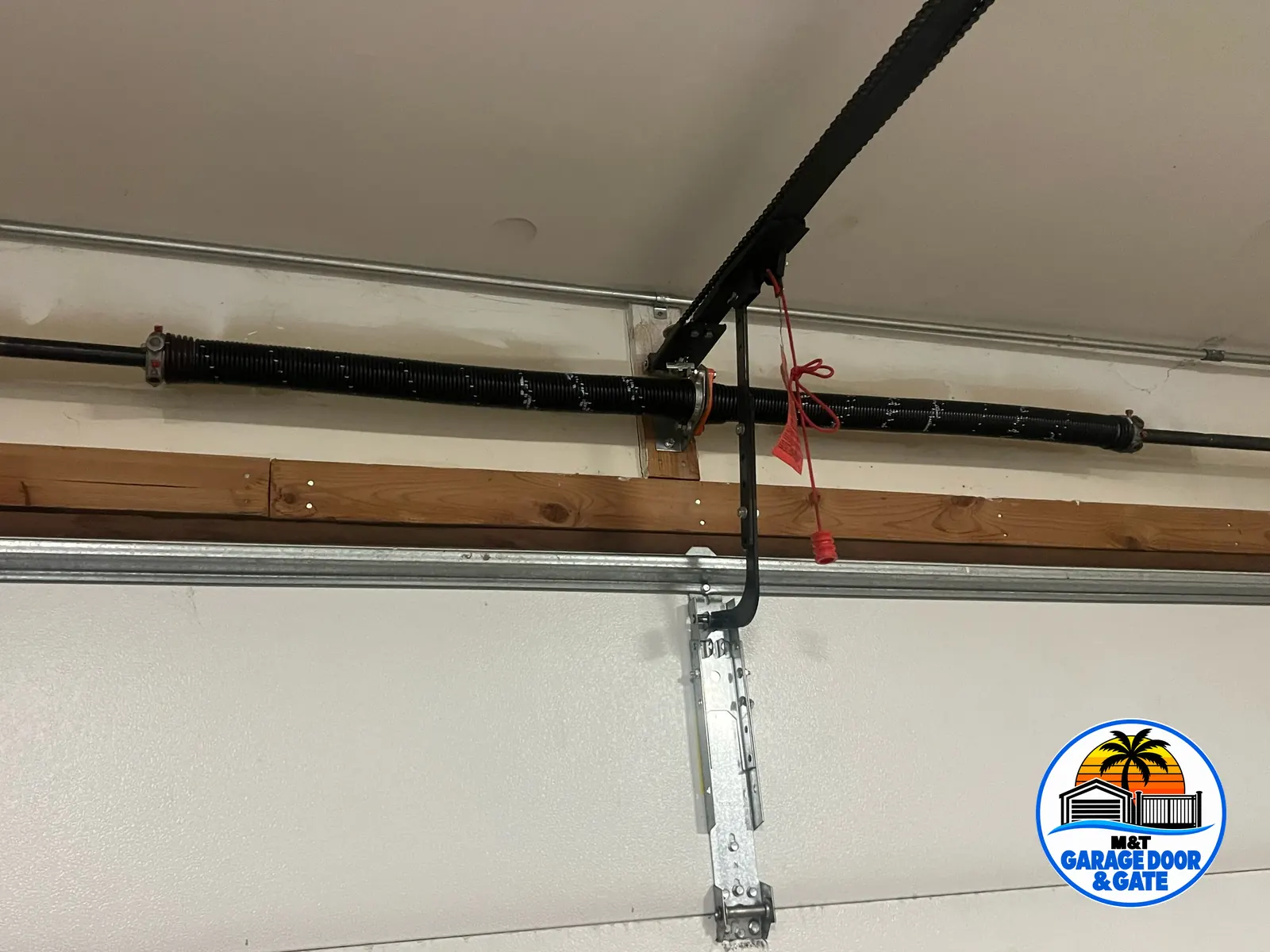
Stand inside the garage with the door closed and look at the wall just above the top of the door. If you see one or two thick coils wrapped around a steel bar that spans the width of the door, those are torsion springs. The bar is the torsion shaft, and it ends in a cable drum at each side.
If that wall is bare and you see long springs running front to back near the ceiling, above each horizontal track, those are extension springs. One end hooks to a hanger at the back of the track and the other to a pulley. A cable passes over that pulley and drops to a bracket at the lower edge of the door.
A third, less common style hides the spring inside a tube on the bar above the door. It works on the torsion principle, so for repairs it belongs in that family, though its parts are different.
How each spring type works
A torsion spring lifts by twisting. As the door closes, the cables unwind from the drums and turn the shaft, winding the spring tighter. Going up, the stored twist is released through the shaft into the drums, which reel in the cables and raise the door. The force is shared across the shaft, so the door rises evenly.
An extension spring lifts by stretching. As the door closes, the springs stretch along the ceiling; as it opens, they contract, and the pulleys turn that pull into lift at the bottom corners. Extension springs always come as a pair, one per side, and each one needs a safety cable through its middle to hold it if it breaks.
Either type has to suit the particular door it holds up, both its weight and its height. Too much spring and the door floats up by itself; too little and it stays heavy, which wears out the opener.
Which homes have which
Torsion springs are the norm on most doors built in recent decades, including the double doors common on newer subdivision homes across Tampa Bay. They handle heavy, wind-reinforced doors well, and the shaft gives a steady, even lift.
Extension springs are more likely on older homes with single-car garages, lighter doors and little headroom, where there is no room above the door for a shaft. Older Tampa bungalows and block ranches are the kind of homes where they often turn up. Some doors on newer houses use them too, so looking up is the only sure answer. If you are buying an older home, look up during the walk-through and check that each extension spring has its safety cable.
How torsion and extension springs fail
Both kinds wear out with use and break eventually. A torsion spring usually goes with a bang and leaves a split you can see in the coil; the door stays down and suddenly weighs far more. On a two-spring shaft, the other spring is still wound, and the door may rise crooked or not at all.
Extension springs can let go more violently, because the stretched spring releases along its whole length. With a safety cable through it, the broken spring is caught and dangles; without one, it can fly across the garage. Extension springs also lose pull as they age, so the door grows heavier and starts closing unevenly from side to side.
Read how to tell a spring broke for the warning signs and what to avoid while you wait for a repair.
What the type means for a repair
We replace both kinds. Torsion springs are wound on the shaft with winding bars and set to the door’s weight. Extension springs are hung, connected to their pulleys and cables, and tensioned by where they hook onto the rear hanger. Neither is a homeowner job, because the stored energy in either type can cause serious injuries.
When an extension spring breaks, we replace the pair and check the pulleys, cables and safety cables, since those wear on the same schedule. Torsion repairs include a look at the drums, cables and shaft bearings. See garage door spring replacement for what a spring visit includes, and garage door cable repair if a cable has jumped a drum or a pulley. To get on the schedule, use the booking page or call (813) 836-7187.