

How commercial doors differ from home garage doors
A door at a warehouse, an auto service bay or a restaurant's back entrance runs far more often than a door at home, and it is usually bigger and heavier. Springs, cables, rollers and the operator wear in step with that use. Commercial doors are built with heavier parts for that reason, and their repairs call for parts sized to match.
Two door types cover most businesses. A sectional door has panels hinged together that ride up into horizontal tracks, much like a home garage door built heavier. A roll-up door, also called a rolling steel door, is a curtain of interlocking slats that coils onto a barrel above the opening. Those have their own page: commercial roll-up door repair.
The operators differ too. A commercial operator is a heavier motor, often mounted on the wall beside the door and driving the spring shaft directly instead of hanging from the ceiling. Many have a hand chain for lifting the door when the power is off, and a three-button control for open, close and stop.
Commercial door problems we fix
These are the calls that come in from businesses most often:
- Broken torsion springs: the door won't lift, or the operator strains and stops
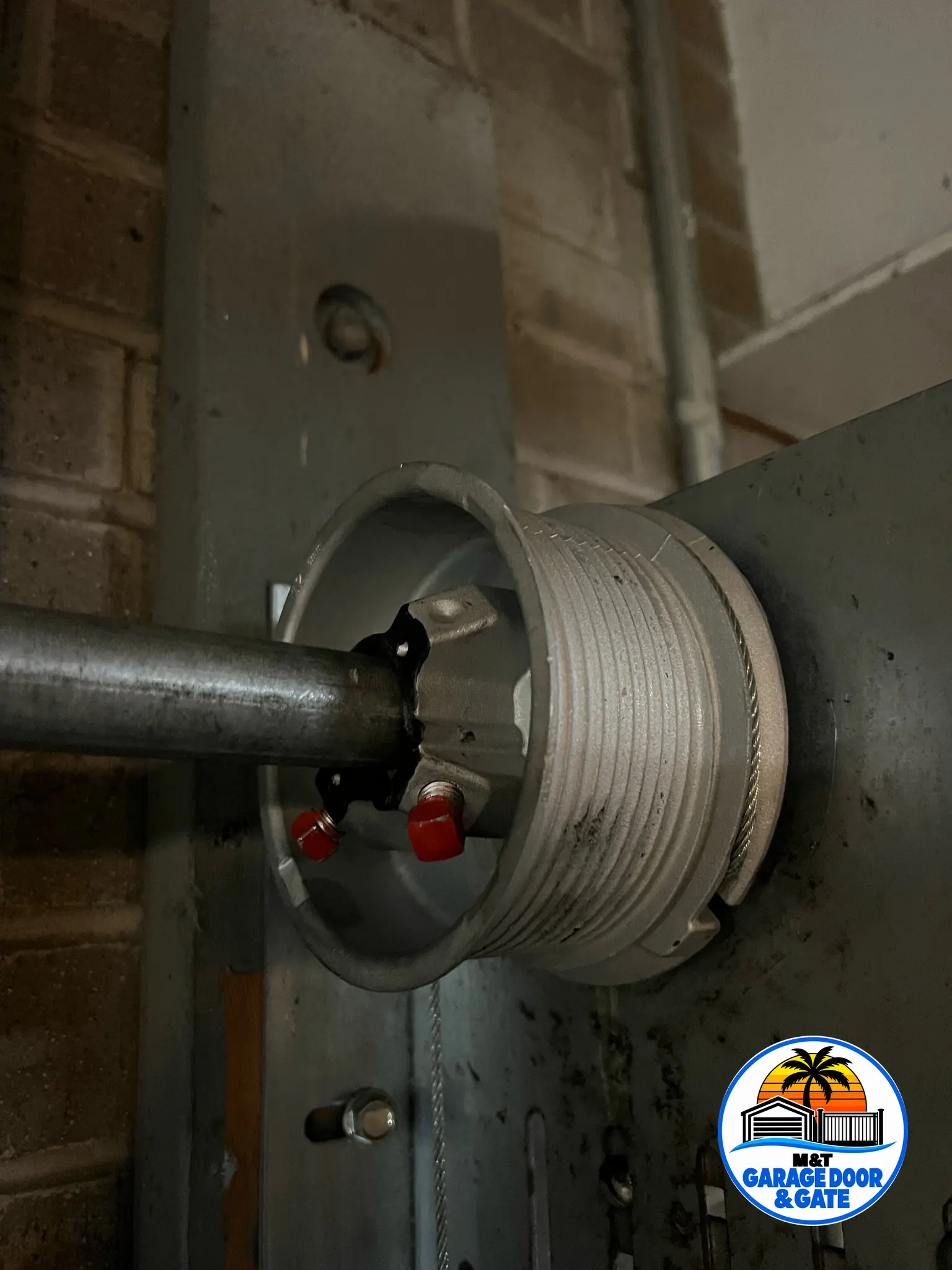
- Frayed or snapped lift cables, and cables off their drums
- Bent tracks and broken rollers after a truck, forklift or cart hit the door
- Operators that hum, stop partway, reverse or ignore the controls
- Photo eyes and safety edges knocked out of line
- Locks, slide bolts and bottom seals worn out by daily use
Springs deserve a word of their own. Torsion springs, the wound steel coils on the shaft over the door, tire a little with every open-and-close cycle. On a busy door the springs are often the first major part to go. We size springs to the door's weight and set the balance, the same way our spring replacement work is done on homes, with springs made for the heavier door.
For the operator, we test the motor, the controls, the limit settings and the safety devices, much as on a home opener repair, using parts built for commercial duty.
Keeping your business running during a repair
A door stuck open leaves stock and tools exposed; a door stuck shut stops deliveries and customers. When you call (813) 836-7187, tell us which matters more at your site, and when the door can be out of use. We set the visit time with you on the phone. Our first goal is a door that is safe and can be locked, then the full repair.
Before you call, a few checks can save a visit. Is the operator's power or disconnect switch on? Is a slide bolt or padlock still engaged? Are the safety sensors near the floor blocked by pallets, boxes or trash? Does the door move with the hand chain? Springs, lift cables and the brackets at each lower corner carry the door's weight under tension, so nobody on staff should loosen or pull on them. Property managers often ask about coverage: we are fully insured.
Where commercial overhead doors take a beating
Commercial overhead doors close off warehouses and small shops, auto repair bays, restaurant and grocery receiving areas, storage buildings and the service entrances of apartment and office buildings. We work on the door and its operator at each of them.
Location changes how a door wears. Near the water in Clearwater and St. Petersburg, salt air rusts springs, cables and bottom brackets. Inland in Plant City and Lakeland, summer heat and dust are harder on rollers and operators. We also repair commercial doors in Pinellas Park and East Lake-Orient Park.
Many doors here are built with wind bracing: steel struts across the sections and heavier track brackets. When we repair one, the bracing goes back exactly as the door was built. Our wind rules answer explains the 140 mph line behind those rules.
What our commercial work covers, and what it doesn't
Our work is repair of doors already in place. Taking out a whole door and hanging another is permit work, so a door that is past repair goes to a company that does replacements.
Small warnings come before most breakdowns: a door that drifts down when you let go of the chain, a new grinding noise, a cable that looks fuzzy, an operator that needs two tries. Our answer on the signs a garage door needs repair applies to commercial doors as well, and catching them early beats a door stuck at closing time.
How a visit goes
- Call and describe the doorTell us the door type, what it is doing and when it can be out of use, and we set the visit with you.
- Make it safe and lockableA door that is hanging, crooked or stuck open is secured first, so the building can be closed.
- Repair the worn partsWe repair or change the springs, cables, rollers, tracks, operator parts or locks that failed.
- Test the safety devicesSeveral open-and-close runs follow, with the sensors, the safety edge and the reversing tested before the door is handed back.