

How the tracks guide the door
On both sides, the rail climbs the wall beside the opening, bends through a curved radius piece near the header, then carries on flat along the ceiling toward the back of the garage. Jamb brackets bolt the vertical track to the wall beside the opening, a flag bracket joins it to the curve, and steel hangers hold up the back end of the horizontal track.
The vertical tracks are set with a slight slant, so the door presses against the frame as it closes and eases away from it as it rises. The rollers need a steady gap inside the rail: too tight and they bind, too loose and they can work their way out. A door only runs well while the two sides stay parallel.
Signs the track needs attention
Track trouble usually announces itself as noise first, then as a door that catches. Look along both rails for these:
- A dent, kink or flattened spot in the rail, often at bumper height.
- Rollers rubbing one edge of the track, or sitting loose with a wide gap.
- Bolts backing out of the jamb brackets, or a bracket pulling away from a block wall.
- A shudder or a bang where the door rounds the curve.
- A horizontal track sagging at the back because a hanger bent or came loose.
- Rust eating the bottom of the vertical track, where it meets a wet floor.
If the door has already slipped out of the rails, it needs off-track repair first. If it closes and then backs up or stops short, see a door that won't close.
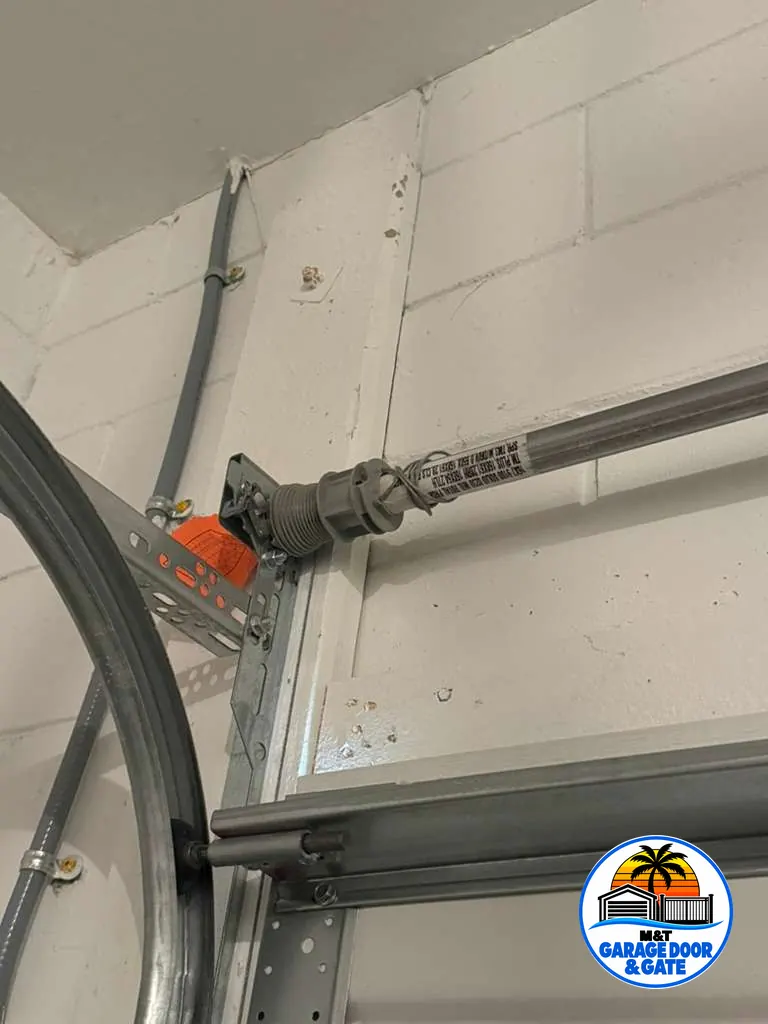
What bends or loosens a track
A bumper is the usual culprit. Even a slow tap on the vertical track bends it enough to catch rollers, and the next trip up can derail the door. Storm wind pushing the door inward is another: it can bow the tracks apart or kink the curve. After a storm, storm damage repair looks at the door and its hardware together.
Slow causes count too. Lag screws loosen in concrete block over the years, boxes and bikes get leaned against the rail, and ceiling hangers sag under shelves that were never meant to hang there. Worn rollers that bind also tug on the track with every trip, which works the bolts loose.
Track repair that keeps the wind bracing
A shallow dent can be eased back out with the right tools, but a creased or twisted rail is replaced, because it will keep catching rollers. Loose brackets are anchored again into solid block or wood, the vertical tracks are set back to the correct slant, and the gap to each roller is made even from bottom to top.
Wind-rated doors often use heavier track and extra brackets as well as struts across the sections. Where a home lies in the wind-borne debris region (the 140 mph line on the code maps), that bracing is part of how the door holds in a hurricane. A track repair keeps every strut, bracket and fastener in place, and any piece that is replaced matches the one that came off. Our guide to garage door wind rules in Tampa Bay explains the labels and the line.
Rollers often wear along with a damaged track, so roller and hinge repair tends to join the same visit.
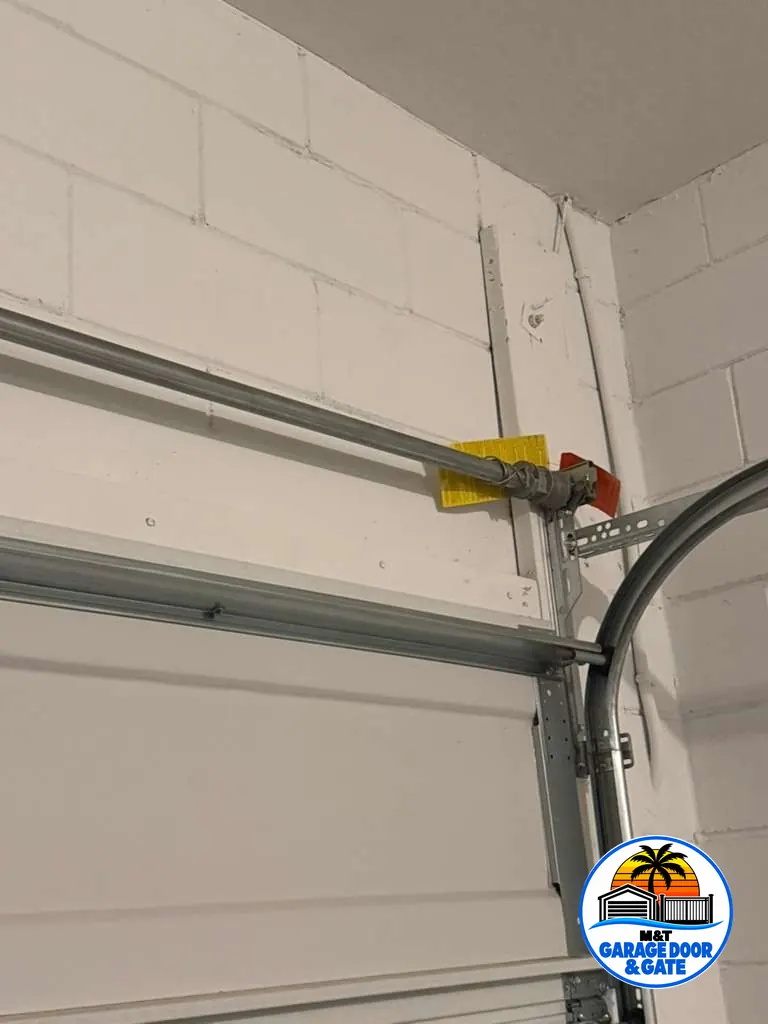
Track repair across Tampa Bay
We straighten and re-anchor tracks across the bay in St. Petersburg, in Town 'n' Country, Palm River-Clair Mel and Riverview in Hillsborough County, up in Wesley Chapel, and out in Lakeland in Polk County.
How a visit goes
- Sight down both railsBoth tracks are checked for plumb, slant, dents and the gap to each roller.
- Secure before looseningClamps lock the door before a single bracket bolt is backed off, since the track carries part of its load.
- Straighten, replace, re-anchorDents are eased out, creased pieces are replaced, and brackets are fastened into solid material.
- Run and fine-tuneThe door makes full trips while the tracks are adjusted, until the rollers turn evenly from floor to ceiling.