

Four reasons a garage door won’t open
Start with what happens when you press the wall button. Silence, with the opener light dark, points to power. A click or a flashing light with no motor sound points to a lock setting or a control fault. A motor that hums or runs while the door stays down points to a broken spring, a stripped gear or a trolley that has come unhooked.
The safety sensors are rarely to blame here. On standard home openers, photo eyes only stop a door from closing, so a dirty lens will not keep it shut. A door that rises a few inches and then reverses is a different story: the opener is feeling far more weight than it should, which leads straight back to the springs.
The springs do the heavy lifting, not the motor. A balanced door feels light because the springs carry most of its weight while the opener steers. When a spring snaps, the opener suddenly faces the full load, strains for a second or two, and quits.
Power, lock mode and the remotes
If nothing happens at all, look at the opener’s own light and the outlet it plugs into. Garage outlets are often GFCI outlets with a reset button, and those trip in storms and damp weather. A tripped breaker does the same. If the whole house is dark, the opener cannot run until power returns unless it has a battery backup; our guide to opening the door during an outage walks through doing it by hand.
If the wall button works but the remotes do nothing, look at the wall control for a lock or vacation setting, often shown by a blinking light. A remote with a weak battery loses range first, working only up close, before it stops altogether. Keypads run on batteries too.
Many doors also have a slide lock on the inside: a handle that pushes a bar through a hole in the track. If someone engaged it, the opener will strain against the bar. Pull it back before anything else, then look at the top of the door to make sure the opener did not bend it while pulling.
Checking for a broken spring from a safe distance
Stand back and look up at the steel bar across the top of the opening. A torsion spring that has broken usually shows a clear gap of a few inches where its coil came apart. On doors whose springs run along the ceiling beside each track, a broken one hangs loose or sits out of place next to its partner. Many people also recall a bang from the garage, sharp like a firecracker, a little earlier.
Other clues: the lift cables hang slack at the sides, the door sits a little crooked, or the opener raises it a few inches and stops. If you see any of these, do not try the door again, by hand or by remote. With a spring gone, the full weight of the door ends up in your hands, and it can fall the moment your grip slips.
Springs are something we replace, never something to adjust at home. Our page on garage door spring replacement explains what that visit involves and why both springs are often done together.
The motor runs but the door stays shut
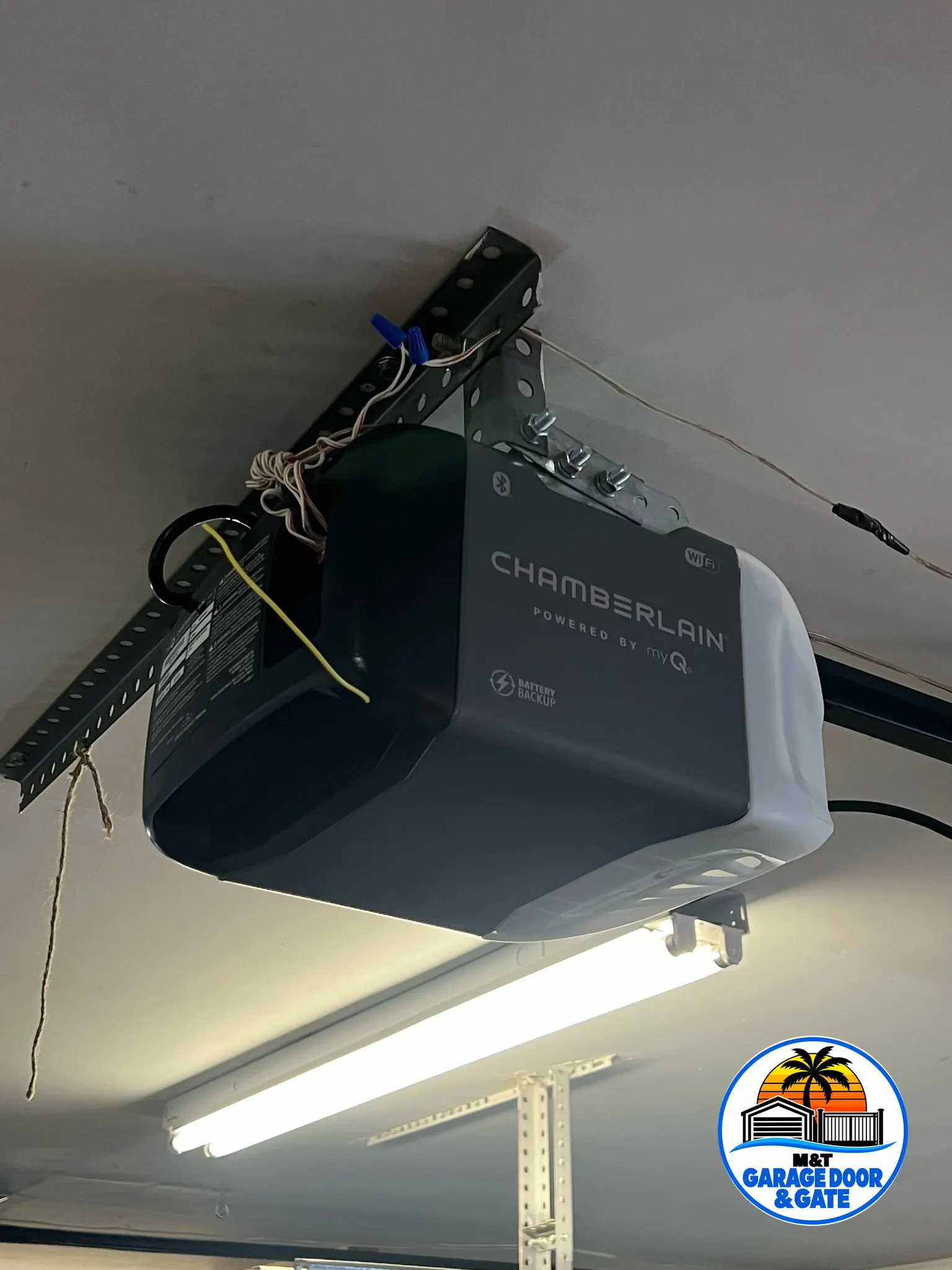
If the motor sounds normal and the chain or belt moves while the door does not, check the trolley, the carriage on the rail that connects to the door arm. When the red release cord has been pulled, the trolley is unhooked and simply slides along. Running the opener through a cycle often lets it catch again, and your model’s manual shows the exact method.
If the motor hums but nothing turns, the drive gear inside the opener may be stripped. On many chain and belt openers that gear is plastic, and it wears with age and with years of hauling a door whose springs have gone weak. A worn gear, a failed logic board or travel limits that have drifted all fall under garage door opener repair, and repairing the unit is where we start.
When the car is stuck inside
If the springs look whole, nothing is hanging loose and the door is fully down, you can pull the red release cord and raise the door by hand from its handle or bottom edge. It should rise steadily and feel manageable. If it feels like dead weight, or it will not stay up, lower it gently and stop: forcing it can bend the bracket where the opener arm attaches, or bring the door down on someone.
If the door will not budge or something looks broken, leave it closed and phone us at (813) 836-7187, or request a repair online. Describe what you heard and saw; it helps us plan the visit.