

Side springs on older Pinellas Park doors
On the oldest houses in town, a garage door often lifts on extension springs. Instead of one coil on a bar over the opening, a long spring runs beside each horizontal track, stretching as the door comes down and pulling it up as it rises. A safety cable, a thin steel line threaded through the middle of each spring, is there to catch the pieces if a spring snaps.
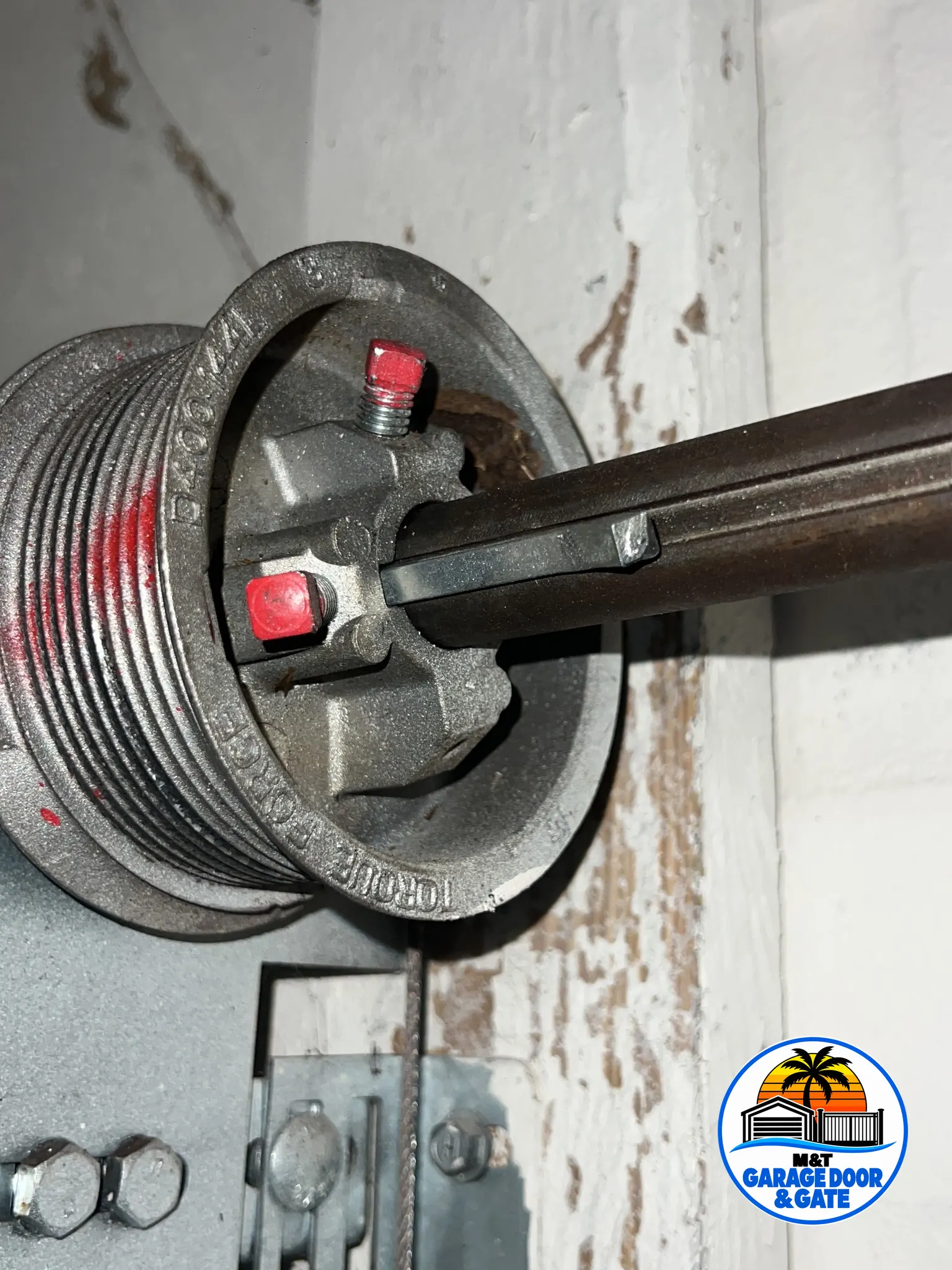
If you see a spring hanging loose, a pulley out of place or no safety cable at all, keep the door closed and stay clear of the springs. They stay under strong tension even with the door down. We handle spring replacement for extension and torsion springs, fit missing safety cables, and check the lift cables and pulleys while we are at it.
Doors on the 15.7% of homes built in 2000 or later mostly use a torsion spring, and it fails much the same way: a bang, then a door too heavy to lift. Most homes here (69.0%) are lived in by their owners. While we are there, it is worth hearing which other parts are close to the end of their life, not only the one that broke.
Low ground, heavy rain and the bottom of the door
Low-lying streets collect water in summer downpours, and the bottom of a garage door takes the brunt. A cracked or flattened bottom seal lets in water, leaves and bugs; weather seal repair fits a fresh strip at the bottom and along the sides. Standing water also rusts the bottom brackets and lowest rollers, so we look at those on every visit.
Salt air still makes it here, even though the city is mostly inland, and rusty rollers and stiff hinges follow. Roller and hinge repair quiets a door that grinds, and a yearly tune-up keeps the hardware oiled and the door in balance.
Tracks bent by a car or held by loose bolts call for track repair; rollers sitting outside the track call for off-track repair. On the motor side, opener repair deals with drive gears, circuit boards, sensors and stop settings, and there are pages for LiftMaster, Chamberlain and Genie owners. For remotes that quit, see remote and keypad programming.
Pinellas Park permits and the 145 mph line
Pinellas Park is an incorporated city with its own permit office.
A full door replacement needs a building permit from City of Pinellas Park Building Development Division. We only repair existing doors.
The county's code amendment sets 145 mph (Risk Category II) everywhere in Pinellas, so this inland city still falls within the wind-borne debris region. A door built for that region relies on its struts and reinforcement, and a repair must leave them in place. Our wind rules guide explains the label on the door, and the hurricane season checklist covers what to look at before June.
Gusts that have already kinked a rail or torn a hinge loose are a job for storm damage repair, and a pre-season hurricane check is the visit to book beforehand. If the door is jammed open, ask for emergency repair.
Pinellas Park at a glance
- Pinellas County; Pinellas Park is an incorporated city that issues its own permits.
- Permit office: City of Pinellas Park Building Development Division.
- Median year built 1978; 56.7% of homes from before 1980, 15.7% from 2000 or later.
- 52.4% single-family detached and 69.0% owner-occupied; 15.3% mobile homes.
- Mostly inland and low-lying, between the two bays, with salt air still reaching it.
- Wind design 145 mph (Risk Category II), inside the wind-borne debris region.
- Spanish is the home language of 9.3% of residents five and older.
- ZIP codes: 33781, 33782.
Largo, St. Petersburg and Clearwater nearby
Elsewhere in the county we cover Largo, St. Petersburg and Clearwater, and the main garage door repair page lists every service. For a driveway gate, we take on gate operator repair as well as sagging or dragging gate hardware. Owners of shops and warehouses can see commercial door service and roll-up door fixes.