

What a broken garage door spring looks and sounds like
Springs give way under load, so a break usually happens while the door is closed or just starting to move. The coil fails at its weakest point and unwinds in a fraction of a second. That is the noise people describe, often loud enough to sound like a shelf collapsing or a car door slamming inside the house.
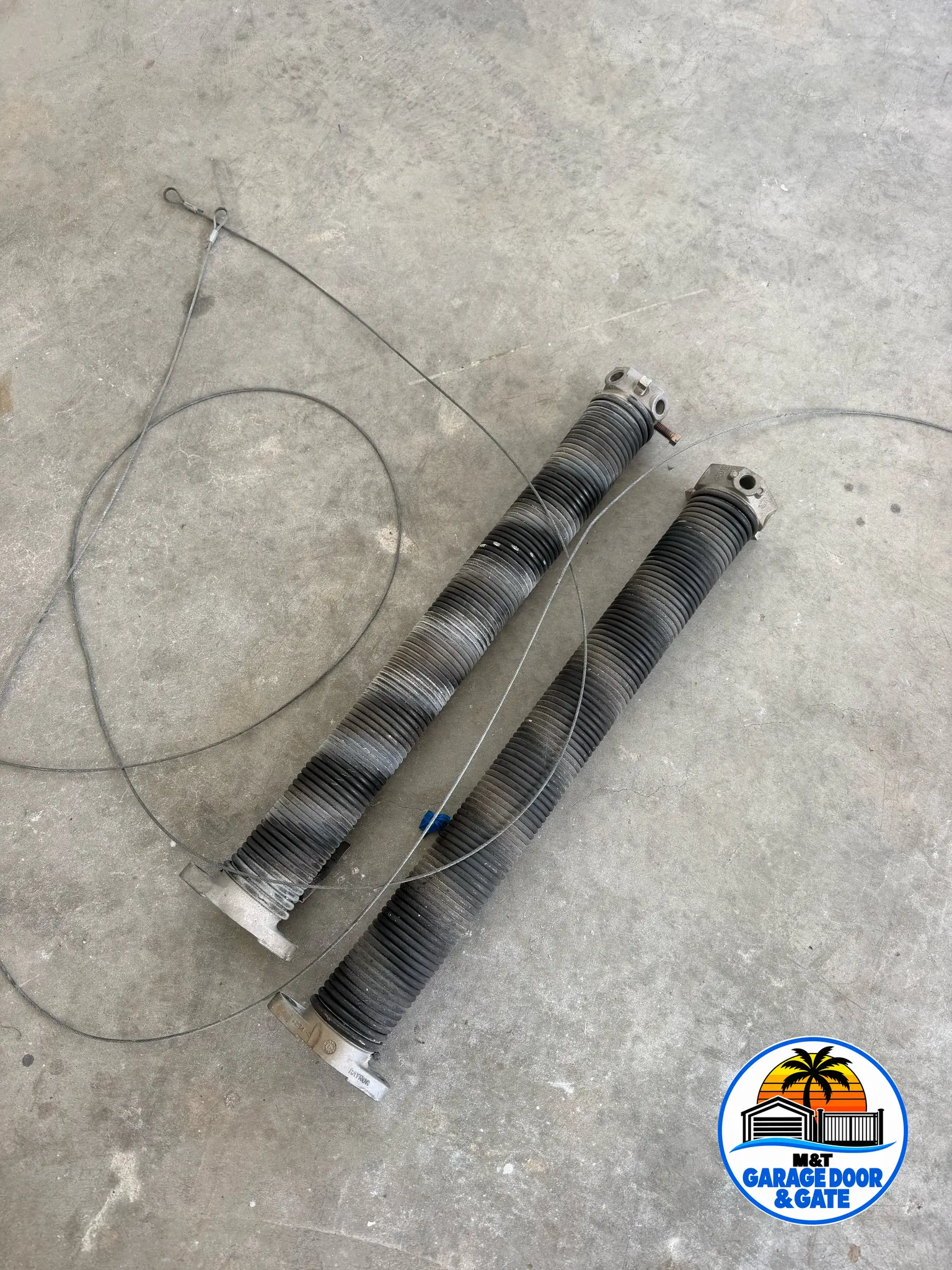
On a torsion spring, the kind wound around a steel bar above the door opening, a break leaves a visible space between two parts of the coil, often a few inches wide. If your door has two torsion springs, compare them side by side: the broken one stands out because its coils no longer line up.
Extension springs stretch along the ceiling beside each horizontal track, and a break there is even easier to spot. The spring may dangle from its safety cable, lie on the floor, or look clearly longer or shorter than its twin. Without a safety cable through it, a snapped extension spring can whip across the garage, one more reason to stay well back.
Other signs the spring is gone
Not every break is easy to see from the floor, especially when the spring sits behind the opener rail. These signs point the same way:
- The door feels extremely heavy, or will not move at all, when you try the handle.
- The opener raises the door a hand’s width or so, then stops or reverses.
- The lift cables on each side hang loose, or one has unwound from its drum near the ceiling.
- The door sits crooked, higher on one side, because one cable lost tension.
- The top of the door is bent near the opener arm, from the opener trying to haul weight the springs no longer carry.
Any one of these, together with that bang, is enough to treat the spring as broken. You do not need to find the gap before you stop using the door.
Why the door should stay put until the repair
A garage door is heavy, and the springs are what make it feel light. With one gone, the whole weight sits on whatever lifts it: the opener’s gear, the arm bracket, or your back. Running the opener can strip its gear or buckle the top of the door. Lifting by hand can work for a moment and then end with the door falling.
Do not try to unwind, tighten or remove a spring, and leave the cables and the bottom brackets alone. On a two-spring door the unbroken spring is still fully wound, and it holds a great deal of energy. Spring work is the one garage job we always ask homeowners to leave to us.
If the door is stuck open, do not close it, and keep cars and children clear until it is secured. If it is closed with a car inside, leave it closed: we raise it safely as part of the repair. Our emergency garage door repair page explains how urgent calls are handled.
How a spring repair visit works
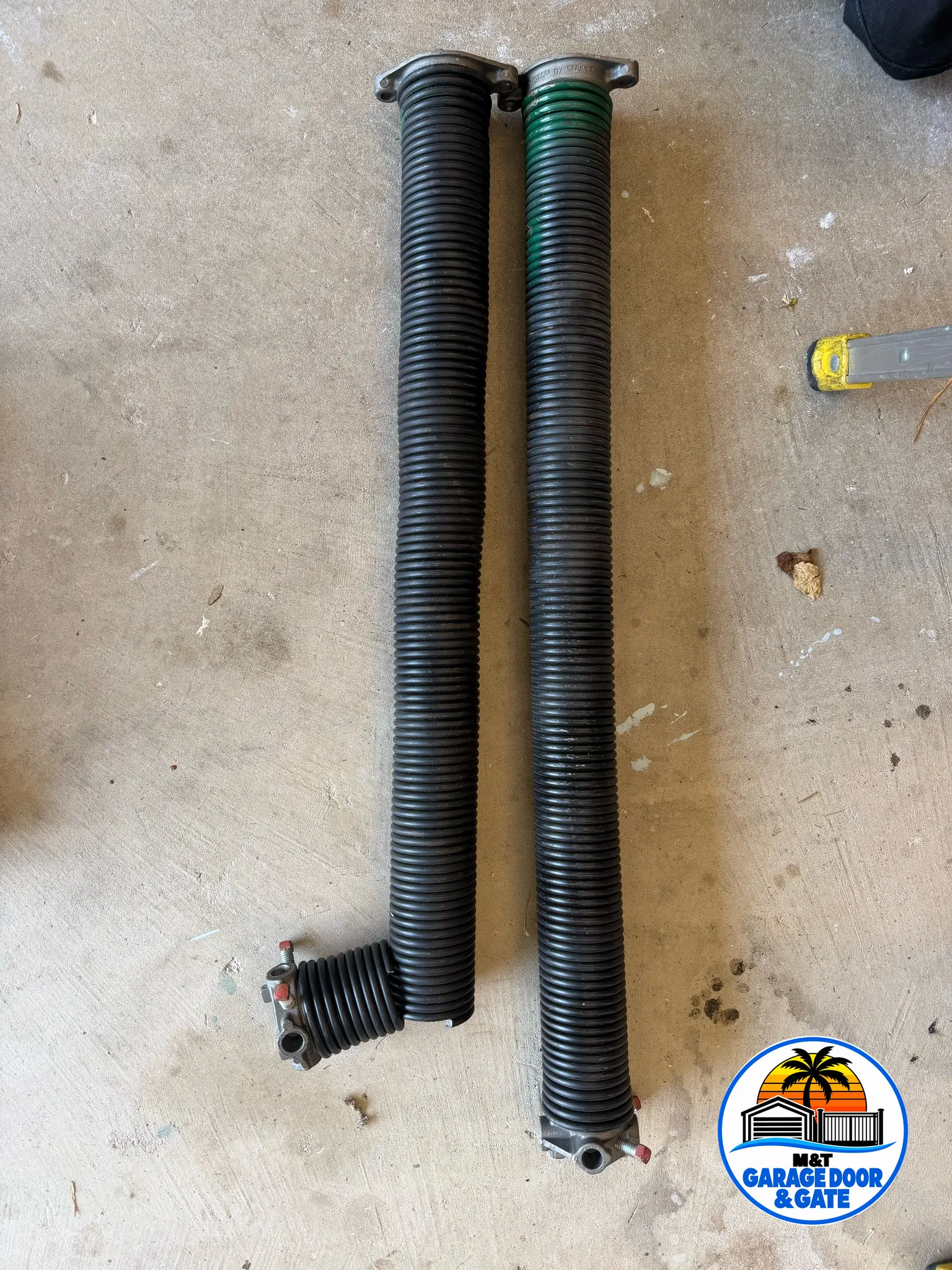
We replace broken springs with springs sized to your door’s weight and height, not with whatever happens to fit the shaft. A spring that is too strong or too weak leaves the door out of balance, which strains the opener and wears the cables. Once the replacement is wound, we stop the door halfway up and let go: a balanced door stays there.
When a door carries two springs, renewing the pair usually makes sense, because the survivor is just as old and just as tired. While the door is apart we also look at the cables, drums, bearings and rollers, since a spring break often comes with wear elsewhere. Our page on garage door spring replacement has more on parts and what to ask.
The visit ends with the opener’s force and travel settings checked, both safety sensors tested and the auto-reverse tried against an object on the floor. A spring break changes how the door moves, so those settings often need a small correction.
How long springs last in a Tampa Bay garage
Springs wear out from use, one open and close at a time. A busy door that runs several times a day reaches the end sooner than one opened twice a week. Humidity and, near the water, salt air add rust, and rust adds friction between the coils. Misting the coils with lubricant made for garage doors a few times a year helps; our maintenance checklist covers the rest.
No calendar tells you when a spring will fail. Rust spots, coils that look stretched or uneven, or a door that slowly gets heavier are good reasons to have the balance checked before the bang. Call (813) 836-7187 or schedule a spring check online.